Why charts sometimes backfire
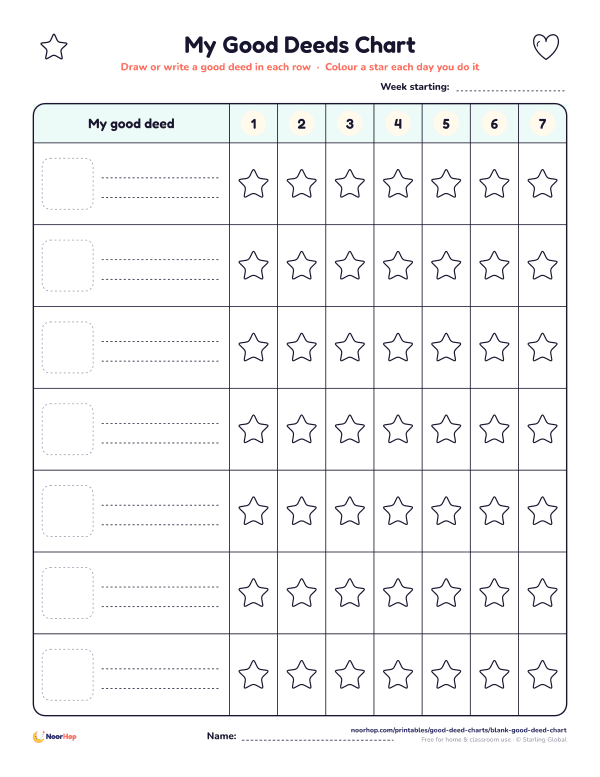
Charts work because children can see their progress. That same power can quietly change the question in a child's head from “How can I be kind?” to “What do I get?”. It usually happens in one of three ways: the prize gets bigger than the deed, the empty boxes start to feel like failures, or brothers and sisters start comparing. Each one has a simple fix.
1. Praise the try, not the result
Colour a shape every time your child tries. A wobbly share is still a share. A salaam whispered from behind your leg is still a salaam. When you colour it in, say exactly what you saw: “You let Musa have the blue crayon even though you wanted it. That was kind.” Specific praise teaches far more than “good girl” or “well done”, and it is what children remember.
Try this sentence: “I saw you ___. That was ___. I'm so happy.”
2. Few habits, big wins
Small children can hold only a few goals in their head. Keep the chart to five habits for ages 2–5 and seven for ages 6–8 at most — fewer is better. Choose habits that happen every day, so there are lots of chances to win.
- Write actions, not character traits: “Said salaam”, not “Be polite”.
- Mix a home habit (tidying, helping) with a people habit (sharing, kind words).
- Let older children choose one row themselves. Ownership is motivating.
3. No X marks, no sad faces, no “bad” rows
An empty box is just an empty box. Never cross a day out, never take a coloured shape away, and never add a row for “bad behaviour”. Children who feel judged by a chart learn to hide mistakes rather than fix them. If a day goes badly, deal with it kindly in the moment — the chart doesn't need to know.
4. Stickers, treats — and the one thing we never trade
For under-fives, colouring the shape is the reward. If you want a celebration when the chart is full, make it about time together: a trip to the park, baking with you, an extra bedtime story. Keep it small so the good deed stays the star.
One rule matters most: worship is never a currency. Don't trade salah, Qur'an or du'a for screen time or sweets. A salah chart can celebrate trying — but the prayer itself isn't something you buy.
5. Make the chart together (10 minutes)
- Pick the moment. Where do you want more kindness? Mealtimes, mornings, playing with siblings?
- Choose three habits together. Ask: “What's a kind thing you could do at dinner?”
- Print it with their name. Use Chart Studio — pick stars, moons or flowers to colour.
- Hang it at their eye level, close to where the habit happens.
- Colour straight after the try, and say what you saw.
- Look back at the end of the week: “What did you try hardest at?” No totals, no ranking.
6. When to retire a chart
Charts are scaffolding, not forever. Retire one when the habits have become automatic, when your child stops caring about it, or after two to four weeks. Make it a little graduation: “You don't need this chart any more — you just do it now!” Keep the old chart in a memory box, take a break, and start a new one only when there's a new habit worth building.
What about brothers and sisters?
Give each child their own chart with different habits, so there is nothing to compare. Or try one family chart where everyone's kind deeds fill the same jar or garden — children cheer each other on instead of competing. The Good Deeds Garden game works the same way on screen: every kind act grows a flower.