
Eid al-Adha for kids
Eid al-Adha, the Festival of Sacrifice, falls on the 10th day of Dhul Hijjah, during Hajj. It remembers the trust in Allah of Prophet Ibrahim (peace be upon him), and families who are able offer a qurbani and share its meat with family, friends and people in need.
Teacher review under way.
Why do we celebrate Eid al-Adha?
For ages 5–8
- Long ago, Prophet Ibrahim, peace be upon him, loved Allah more than anything.
- Allah gave him a very hard test: to give up his dear son, Isma'il.
- Ibrahim and Isma'il both trusted Allah and were ready to do what He asked.
- Because they trusted Him so much, Allah sent a ram instead, and Isma'il was safe.
- Every Eid al-Adha, we remember how much Prophet Ibrahim trusted Allah, and we share food with everyone.
For ages 2–4
Eid al-Adha is a happy day when we remember Prophet Ibrahim, who loved and trusted Allah, and we share food with family, friends and people in need.
Many parents keep the full story for when children are a little older and ready for its questions. Answer simply and calmly: everyone was safe, and Allah was pleased with their trust.
The Qur'an tells this story in Surah As-Saffat (37:99–111). It doesn't name the son; most scholars say it was Isma'il. We tell this story in words only — NoorHop never shows pictures of the Prophets.
The first ten days of Dhul Hijjah
The Prophet Muhammad (peace be upon him) taught that no good deeds are better than those done in the first ten days of Dhul Hijjah (Sahih al-Bukhari 969). Many families make them special at home, a little like the last ten nights of Ramadan:
- one small good deed each day, ticked on a paper chain or chart;
- extra dhikr — SubhanAllah, Alhamdulillah, La ilaha illallah, Allahu Akbar;
- on the Day of Arafah (the 9th), many grown-ups who aren't on Hajj fast (Sahih Muslim 1162), and families make lots of du'a together.
لَبَّيْكَ اللَّهُمَّ لَبَّيْكَ
Labbayk Allahumma labbayk
“Here I am, O Allah, here I am”
The first words of the talbiyah, which pilgrims call out from the time they put on ihram (Sahih al-Bukhari 1549).
Hajj in 8 simple steps
Hajj is the fifth pillar of Islam: a journey to Makkah that grown-ups make once in their life if they are able.
- 1
Ihram
Pilgrims put on simple clothes — for men, two plain white sheets — and say the talbiyah. Everyone looks the same before Allah.
- 2
Tawaf
Walking around the Kaaba in Makkah seven times, all together.
- 3
Sa'i
Walking seven times between the hills of Safa and Marwah, remembering how Hajar ran between them looking for water for baby Isma'il.
- 4
Mina
A huge city of white tents where pilgrims stay and pray.
- 5
Arafah
The most important day: pilgrims stand on the plain of Arafah making du'a until sunset.
- 6
Muzdalifah
A night under the open sky, where pilgrims rest and collect small pebbles.
- 7
Jamarat
Throwing small pebbles at the jamarat, stone walls in Mina. Many teachers explain it as remembering how Prophet Ibrahim turned away from Shaytan.
- 8
Eid & the farewell tawaf
On Eid day: qurbani, a haircut and another tawaf. After a few more days in Mina, a last tawaf to say goodbye to the Kaaba.
A simplified order for children. The full rites have more detail and depend on the type of Hajj — ask your teacher. noorhop.com/eid/al-adha
What is qurbani?
On Eid al-Adha and the days just after it, families who can afford it offer an animal — a sheep, goat, cow or camel — as qurbani, to thank Allah and to remember Prophet Ibrahim's trust. Scholars differ on whether it is required or a strongly recommended sunnah for those who can afford it.
Islam teaches that animals must be treated with mercy: kept calm, given water, and never frightened or hurt for no reason. Today, the qurbani is usually done by trained people, and many families arrange it through a charity, often in another country where meat is scarce.
The meat is shared. Many families divide it into three parts — one for the family, one for friends and neighbours, and one for people in need. That's a common custom rather than a strict rule.
Ways kids can share on Eid al-Adha
Pack a plate
Help carry a plate of food to a neighbour.
Three piles
Sort pretend food into three piles: family, friends, people in need.
Eid cards
Colour Eid cards for grandparents and neighbours.
Hajj talk
Make a model Kaaba from a box and black paper, and talk about the pilgrims walking round the real one.
For Eid al-Adha and Hajj
 Colouring pageCamel in the DesertA friendly camel with a bright saddle blanket strolls past the dunes and a palm-tree oasis.Colour →
 Colouring pageEid Mubarak CardColour a bright Eid card with bubbly letters and عِيد مُبَارَك in Arabic — then give it to someone you love.Colour →GameMasjid JigsawPiece the picture together!Play →Read nextThe five pillars of Islam (Hajj is the fifth)Shahadah, Salah, Zakat, Sawm and Hajj in simple words, with a counting song.Open →
Questions parents ask
How do I explain Eid al-Adha to a child?
Why is Eid al-Adha during Hajj?
When is Eid al-Adha 2027?
Keep learning
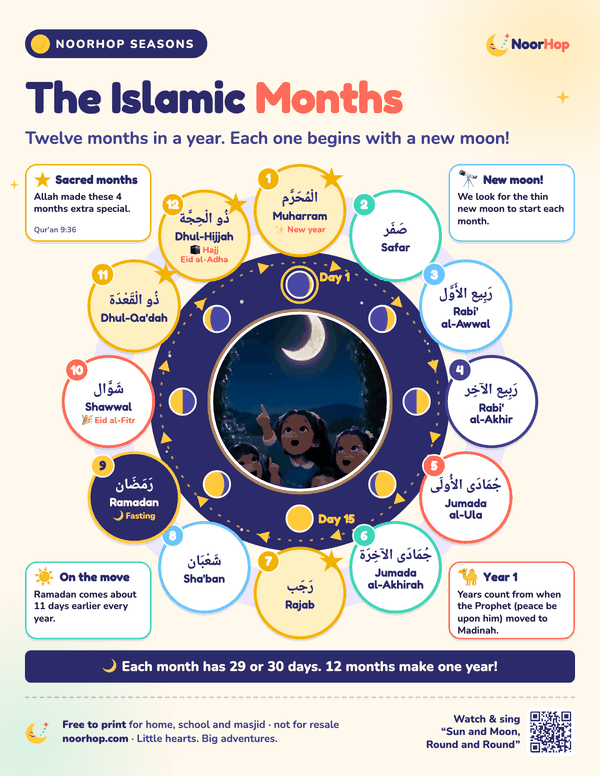
Islamic Months Poster for Kids
A colourful wheel of the 12 Islamic (Hijri) months in order, each with its Arabic name and English spelling, the four sacred months starred, and Ramadan, Eid al-Fitr, Hajj and Eid al-Adha marked.
Open →
Eid Gifts & Balloons
A happy pile of Eid presents tied to a bunch of bouncy balloons.
Open →The five pillars of Islam for kids
Shahadah, Salah, Zakat, Sawm and Hajj in simple words, with a counting song.
Open →Easy Ramadan crafts for kids
Paper lanterns, a paper-plate moon, a sadaqah box and more — with steps.
Open →The Eid takbir
Allah is the Greatest — and all our thanks belong to Allah!
Open →Share the Dates
Fair shares at iftar!
Open →