
The five pillars of Islam for kids
The five pillars of Islam are the five main acts a Muslim's life is built on: the Shahadah (believing and saying there is no god but Allah and Muhammad ﷺ is His messenger), Salah (praying five times a day), Zakat (giving to people in need), Sawm (fasting in Ramadan) and Hajj (the pilgrimage to Makkah, once in a lifetime for those who are able).
Teacher review under way.
Why “pillars”?
A pillar holds a building up. The Prophet Muhammad (peace be upon him) taught that Islam is built on five — just like a house standing on five strong pillars. (Reported in Sahih al-Bukhari and Sahih Muslim.)
Hold up one hand: each finger is a pillar. Count them together — Shahadah, Salah, Zakat, Sawm, Hajj — and your hand holds up the whole house!
One, two, three, four, five
- 1
الشَّهَادَة
Shahadah
Bearing witness
We believe and say that there is no god but Allah, and that Muhammad (peace be upon him) is His messenger.
Little ones can: Say “La ilaha illallah” together at bedtime.
- 2
الصَّلَاة
Salah
Prayer
We pray to Allah five times every day.
Little ones can: Stand beside a grown-up for one prayer.
- 3
الزَّكَاة
Zakat
Giving
Muslims whose savings reach a set amount give a small part of them every year to people in need.
Little ones can: Put a coin in a sadaqah box — practice for giving.
- 4
الصَّوْم
Sawm
Fasting
In Ramadan, grown-ups fast from dawn to sunset. Children practise when they are ready.
Little ones can: Help at iftar and pass round the dates.
- 5
الْحَجّ
Hajj
Pilgrimage
Once in their life, grown-ups who are able travel to the Kaaba in Makkah for Hajj.
Little ones can: Walk seven times round a cushion “Kaaba” and talk about the pilgrims.
noorhop.com/learn/five-pillars
The Shahadah
Short and simple
لَا إِلَٰهَ إِلَّا اللَّهُ مُحَمَّدٌ رَسُولُ اللَّهِ
La ilaha illallah, Muhammadur rasulullah
“There is no god but Allah, and Muhammad ﷺ is the Messenger of Allah”
In full, for older children
أَشْهَدُ أَنْ لَا إِلَٰهَ إِلَّا اللَّهُ، وَأَشْهَدُ أَنَّ مُحَمَّدًا رَسُولُ اللَّهِ
Ash-hadu an la ilaha illallah, wa ash-hadu anna Muhammadan rasulullah
“I bear witness that there is no god but Allah, and I bear witness that Muhammad ﷺ is the Messenger of Allah”
These are the most important words in Islam. “Shahadah” means bearing witness, so the full words begin with “Ash-hadu” — “I bear witness”. Little ones can start with the first part, “La ilaha illallah”, and add the rest as they grow.
5 Pillars of Islam — Count with Me!
Count the five pillars on your fingers with Noori — a song made for little ones.
Build a five-pillar house
- Collect five kitchen-roll tubes and a piece of card for the roof.
- Colour each tube and write a pillar name on it (you write, they decorate).
- Stand the tubes in a row, then balance the roof on top.
- Take one tube away — what happens? Talk about why every pillar matters.
More about the pillars
Wudu, salah & more
- Ages 3–8Salah for kids, step by stepThe steps of salah for kids, with the words to say, audio and a printable card.
- Ages 3–8Wudu steps for kidsSimple picture steps with audio, a printable poster and the Wudu Steps game.
- Ages 4–8The five daily prayers for kidsFajr to Isha: time of day, Arabic names with audio and rak'ahs.
- Ages 2–8Masjid manners for kidsSimple masjid manners, tips for toddlers and a printable card.
- Ages 3–8Jumu'ah for kids: making Friday specialWhy Friday is special, a kids' sunnah list, a family routine and a printable checklist.
Questions parents ask
What are the five pillars of Islam for kids?
How do I teach the five pillars to a preschooler?
What is the difference between the pillars of Islam and the pillars of iman?
Sources: Sahih al-Bukhari 8 · Sahih Muslim 16
Arabic is copied letter for letter from trusted sources (Qur'an: tanzil.net / quran.com; hadith: sunnah.com). A teacher review is under way. Families and madhhabs differ on some details — ask your teacher.
Keep learning
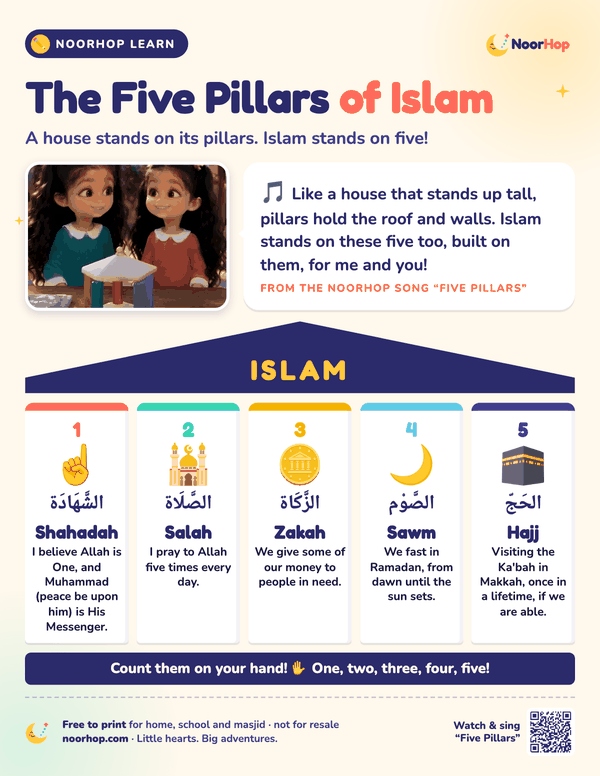
Five Pillars of Islam Poster for Kids
A five pillars of Islam poster for children that shows Islam as a house standing on five pillars: Shahadah, Salah, Zakah, Sawm and Hajj, each with its Arabic name, a picture and one simple sentence.
Open →Zakat al-Fitr explained for kids
The Eid charity in kid-sized words, with a family share counter.
Open →5 Pillars of Islam — Count with Me!
Open →Prayer Sky
When do we pray?
Open →Du'a for Every Moment
Tap a moment to hear its du'a, track what your child knows, pick a du'a of the week and print personalised cards.
Open →Eid al-Adha for kids
The story told gently, Hajj in simple steps, qurbani explained kindly and sharing.
Open →