
Wudu steps for kids
Wudu is the washing Muslims do before salah. Kids learn it best in small steps: intention and Bismillah, then wash the hands, mouth, nose, face and arms, wipe the head and ears, and wash the feet — the right side before the left, and each washing up to three times.
Teacher review under way.
The steps of wudu for kids
- 1Intention & BismillahMake your intention and say Bismillah.
- 2Wash handsWash your hands three times.×3
- 3Rinse mouthRinse your mouth three times.×3
- 4Rinse noseRinse your nose three times.×3
- 5Wash faceWash your face three times.×3
- 6Wash arms to elbowsWash your arms up to the elbows three times, right first.×3Right first
- 7Wipe headWipe over your head.
- 8Wipe earsWipe your ears.
- 9Wash feet to anklesWash your feet up to the ankles three times, right first.×3Right first
This is the order as it is commonly taught. Washing once is enough for each part; up to three times is the sunnah.
What must be done, and what is sunnah
Named in the Qur'an (5:6)
- Wash the face
- Wash the arms up to the elbows
- Wipe over the head
- Wash the feet up to the ankles
From the sunnah
The way the Prophet Muhammad ﷺ made wudu adds the rest: Bismillah, washing the hands, rinsing the mouth and nose, wiping the ears, the right side first, and washing up to three times.
Some madhhabs count more steps as required — such as the intention, keeping the order, not leaving long breaks, rinsing the mouth and nose, or saying Bismillah. Children simply learn the whole wudu, every step, every time.
Play the Wudu Steps game
Drag the pictures into the right order to help Noori get ready for salah. Great before a real practice at the sink.
My wudu steps
- 1Intention & Bismillah
- 2Wash hands×3
- 3Rinse mouth×3
- 4Rinse nose×3
- 5Wash face×3
- 6Wash arms to elbows×3· right first
- 7Wipe head
- 8Wipe ears
- 9Wash feet to ankles×3· right first
Families and madhhabs differ on some details — ask your teacher. noorhop.com/learn/wudu
Teaching wudu to kids
Ages 2–3
- Wash hands together, saying Bismillah.
- Splash-and-count: “one, two, three”.
- Let them watch your wudu and copy.
Ages 4–5
- Learn the order with the game and the poster.
- Practise two or three steps at a time.
- Use a steady step stool and a towel of their own.
Ages 6–8
- Do the whole wudu with you nearby.
- Remember: right side first.
- Learn simply what breaks wudu (see below).
Easy fixes
- Mixed-up order. Play the game, then point at the poster as you go.
- Lots of splashing. Show how a cupped handful is enough — water is a gift.
- Wet sleeves. Roll them up above the elbows before starting.
- Forgetting the feet. Sit on a stool by the bath or use a jug — safer than lifting feet into the sink.
What breaks wudu? (simply)
In simple words: going to the toilet, passing wind, and falling into a deep sleep. After any of these, we make wudu again before salah.
There are other cases and the madhhabs differ on some of them — older children can learn the details with their teacher.
More wudu practice
 Colouring pageWudu Water JugA pretty water jug pouring clean, sparkly drops into a basin — ready for wudu!Colour →
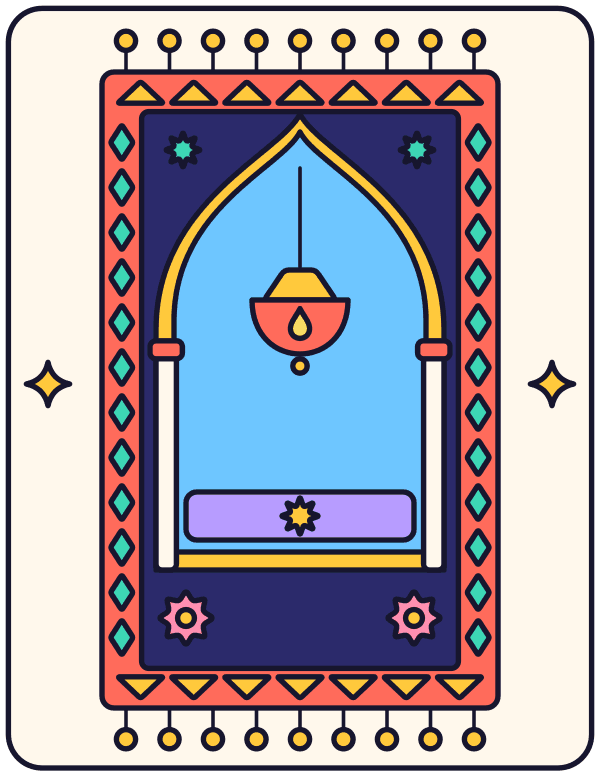 Colouring pageMy Prayer MatA beautiful prayer mat with an arch, a hanging lamp and a geometric border to decorate.Colour →GamePrayer SkyWhen do we pray?Play →
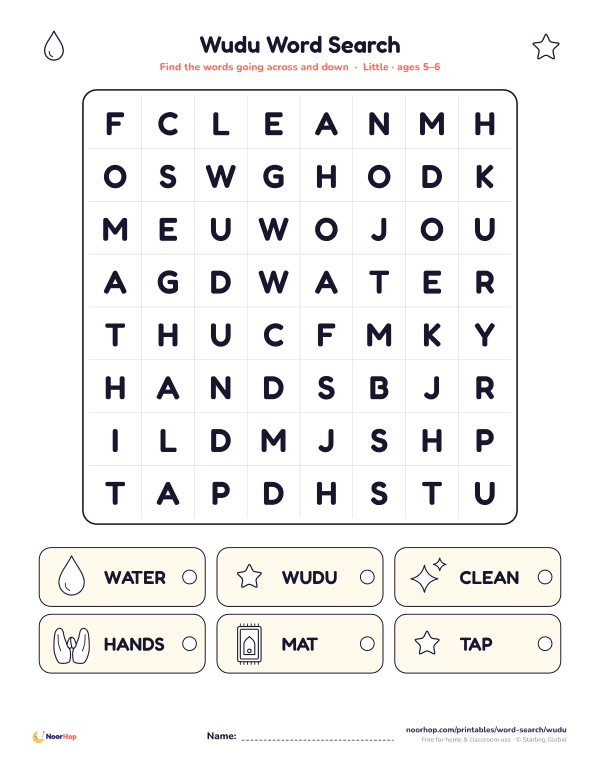 PrintableWudu word searchA wudu word search in two levels: find WATER, HANDS and CLEAN in the picture puzzle, then BISMILLAH, MOUTH, NOSE and FEET in the bigger grid.Print →
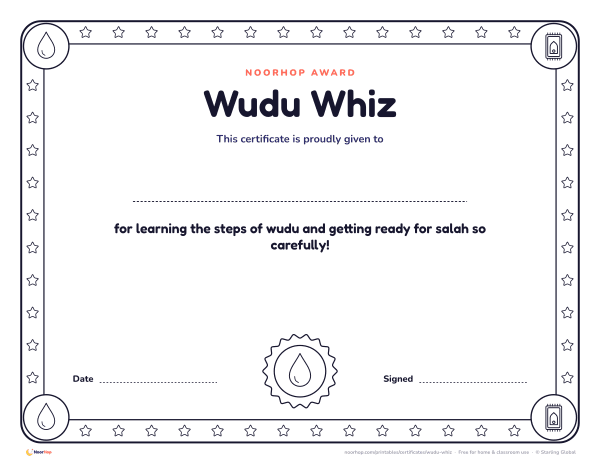 PrintableWudu Whiz certificateThe Wudu Whiz certificate says “well done” for learning the steps of wudu and getting ready for salah so carefully.Print →
Wudu, salah & more
- Ages 3–8Salah for kids, step by stepThe steps of salah for kids, with the words to say, audio and a printable card.
- Ages 4–8The five daily prayers for kidsFajr to Isha: time of day, Arabic names with audio and rak'ahs.
- Ages 3–8The five pillars of Islam for kidsShahadah, Salah, Zakat, Sawm and Hajj in simple words, with a counting song.
- Ages 2–8Masjid manners for kidsSimple masjid manners, tips for toddlers and a printable card.
- Ages 3–8Jumu'ah for kids: making Friday specialWhy Friday is special, a kids' sunnah list, a family routine and a printable checklist.
Questions parents ask
What are the steps of wudu for kids?
At what age should a child learn wudu?
How many times do you wash each part?
Sources: Qur'an 5:6 (Al-Ma'idah) · Sunan Abi Dawud 101 (Bismillah before wudu)
Arabic is copied letter for letter from trusted sources (Qur'an: tanzil.net / quran.com; hadith: sunnah.com). A teacher review is under way. Families and madhhabs differ on some details — ask your teacher.
Keep learning
Wudu Steps
Put the steps in order!
Open →Wudu Word Search for Kids
A wudu word search in two levels: find WATER, HANDS and CLEAN in the picture puzzle, then BISMILLAH, MOUTH, NOSE and FEET in the bigger grid.
Open →Du'a for Every Moment
Tap a moment to hear its du'a, track what your child knows, pick a du'a of the week and print personalised cards.
Open →Ramadan day 14: Wudu: Fresh and Ready
Kind hearts, close to Allah · Wudu is the special washing Muslims do before salah.
Open →Du'a after wudu
There is only one Allah, and Prophet Muhammad (peace be upon him) is His servant and messenger.
Open →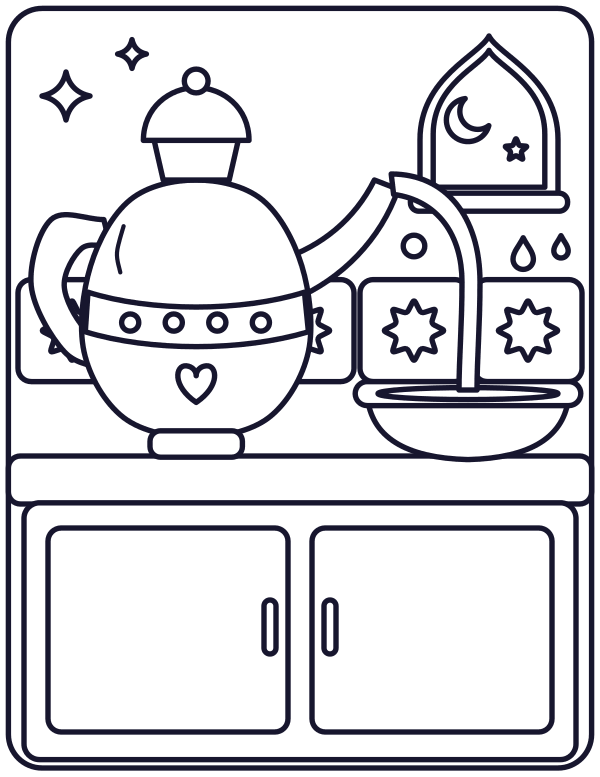
Wudu Water Jug
A pretty water jug pouring clean, sparkly drops into a basin — ready for wudu!
Open →