
Salah for kids, step by step
Salah is the prayer Muslims pray five times a day. Children learn it step by step: make wudu, face the qiblah, say “Allahu Akbar”, then stand, bow, prostrate, sit and finish with salam — beside a grown-up, and with lots of praise for every try.
Teacher review under way.
Getting ready for salah
- 1
Make wudu
Wash in the right order — see wudu steps for kids.
- 2
A clean place
A prayer mat, a towel or any clean spot.
- 3
Face the qiblah
The direction of the Kaaba in Makkah. Mark it at home with a sticker.
- 4
Mean it
In our heart we know which prayer we are about to pray.
The steps of salah, and what we say
One rak'ah is standing, bowing, standing up again and two prostrations. In the required (fard) prayers, Fajr has 2 rak'ahs, Maghrib 3, and Dhuhr, Asr and Isha 4.
- 1
Takbir
Stand facing the qiblah, raise both hands and begin the prayer.
اللَّهُ أَكْبَرُ
Allahu Akbar
“Allah is the Greatest”
- 2
Standing (qiyam)
Stand still and recite Surah Al-Fatiha; in the first two rak'ahs a short surah comes after it. Little ones can listen while a grown-up recites.
آمِين
Ameen
“O Allah, accept — said after Al-Fatiha”
- 3
Bowing (ruku')
Say Allahu Akbar and bow, hands on the knees, back flat like a table.
سُبْحَانَ رَبِّيَ الْعَظِيمِ
Subhana rabbiyal 'adheem
“Glory be to my Lord, the Most Great”
- 4
Standing up again
Rise up straight from the bow.
سَمِعَ اللَّهُ لِمَنْ حَمِدَهُ
Sami'Allahu liman hamidah
“Allah hears the one who praises Him”
رَبَّنَا وَلَكَ الْحَمْدُ
Rabbana wa lakal hamd
“Our Lord, all praise is Yours”
- 5
Prostration (sujud)
Say Allahu Akbar and go down: forehead and nose, hands, knees and toes on the ground. Sit up for a moment, then do a second sujud.
سُبْحَانَ رَبِّيَ الْأَعْلَى
Subhana rabbiyal a'la
“Glory be to my Lord, the Most High”
- 6
Sitting
After the second rak'ah and at the end, sit for the tashahhud. Older children learn its words with their teacher.
- 7
Salam
To finish, turn the head to the right and then to the left.
السَّلَامُ عَلَيْكُمْ وَرَحْمَةُ اللَّهِ
Assalamu alaikum wa rahmatullah
“Peace and the mercy of Allah be upon you”
As commonly taught. Families and madhhabs differ on some details — such as where the hands are placed, whether Ameen is said aloud and how the salam is given — so follow your teacher. noorhop.com/learn/salah
A little at a time
Ages 2–3
Stand on a little mat beside you and copy. One bow or one sujud is a lovely start.
Ages 4–5
Learn the names of the positions and say Allahu Akbar and Ameen together.
Ages 6–8
Learn the words for ruku' and sujud, Al-Fatiha by heart, and pray one prayer a day with you.
Practise salah through play
 Colouring pageMy Prayer MatA beautiful prayer mat with an arch, a hanging lamp and a geometric border to decorate.Colour →
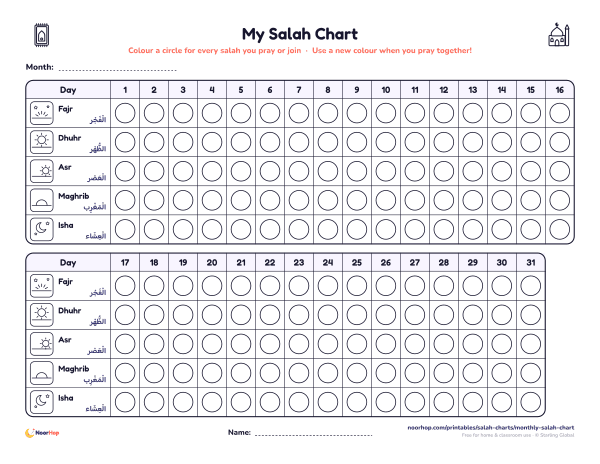 PrintablePrintable salah chartsA salah chart lets children colour a circle for each of the five daily prayers they pray or join.Print →Parent toolChart Studio: a personalised salah chartGood-deeds, salah, sunnah and helping charts with your child's name. Print free in two minutes.Open →Read nextRamadan day 15: Pray Beside MeKind hearts, close to Allah · Salah is the prayer Muslims pray five times every day.Open →
Wudu, salah & more
- Ages 3–8Wudu steps for kidsSimple picture steps with audio, a printable poster and the Wudu Steps game.
- Ages 4–8The five daily prayers for kidsFajr to Isha: time of day, Arabic names with audio and rak'ahs.
- Ages 3–8The five pillars of Islam for kidsShahadah, Salah, Zakat, Sawm and Hajj in simple words, with a counting song.
- Ages 2–8Masjid manners for kidsSimple masjid manners, tips for toddlers and a printable card.
- Ages 3–8Jumu'ah for kids: making Friday specialWhy Friday is special, a kids' sunnah list, a family routine and a printable checklist.
Questions kids (and parents) ask
How do you pray salah, step by step?
What do we say in sujud?
What is a rak'ah?
Sources: Sunan Abi Dawud 871 (words in ruku' and sujud) · Sahih al-Bukhari 789 (takbir and rising from ruku') · Sahih al-Bukhari 812 (sujud on seven parts) · Sunan Abi Dawud 996 (salam)
Arabic is copied letter for letter from trusted sources (Qur'an: tanzil.net / quran.com; hadith: sunnah.com). A teacher review is under way. Families and madhhabs differ on some details — ask your teacher.
Keep learning
Du'a for Every Moment
Tap a moment to hear its du'a, track what your child knows, pick a du'a of the week and print personalised cards.
Open →Du'a after wudu
There is only one Allah, and Prophet Muhammad (peace be upon him) is His servant and messenger.
Open →Wudu Steps
Put the steps in order!
Open →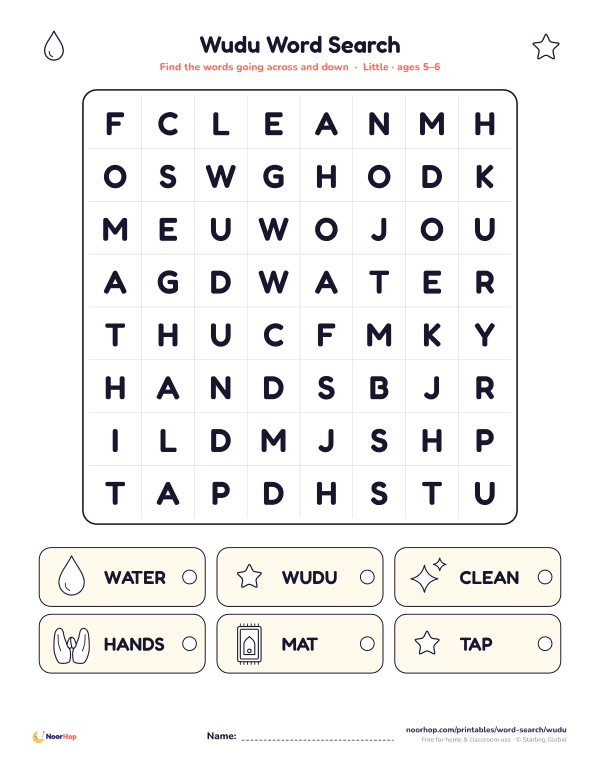
Wudu Word Search for Kids
A wudu word search in two levels: find WATER, HANDS and CLEAN in the picture puzzle, then BISMILLAH, MOUTH, NOSE and FEET in the bigger grid.
Open →Allahu Akbar — meaning for kids
Allah is greater than everything!
Open →How to teach your child salah, age by age (2–8)
Love first, then copying, then words and positions — and charts that encourage, not shame.
Open →