
Du'a after wudu
After wudu we say “Ashhadu an la ilaha illallahu wahdahu la sharika lah, wa ashhadu anna Muhammadan 'abduhu wa rasuluh” — the shahadah, declaring that Allah is One and that Muhammad (peace be upon him) is His messenger.
Teacher review under way.
أَشْهَدُ أَنْ لَا إِلَٰهَ إِلَّا اللَّهُ وَحْدَهُ لَا شَرِيكَ لَهُ، وَأَشْهَدُ أَنَّ مُحَمَّدًا عَبْدُهُ وَرَسُولُهُ
Ashhadu an la ilaha illallahu wahdahu la sharika lah, wa ashhadu anna Muhammadan 'abduhu wa rasuluh
“I bear witness that there is no god but Allah, alone, with no partner, and I bear witness that Muhammad (peace be upon him) is His servant and His messenger.”
Good to know: This is the wording reported in Sahih Muslim. Narrations differ a little — one is shorter, and one in at-Tirmidhi adds a line (see below). Families and madhhabs differ on small details, so follow your teacher.
What it means
“There is only one Allah, and Prophet Muhammad (peace be upon him) is His servant and messenger.”
When we say it
Right after we finish wudu, before we go to pray.
How to teach it in 3 steps
Step 1: Make it the last step of wudu: tap off, dry hands, then say it together.
Step 2: Teach it in two halves — “Ashhadu an la ilaha illallah…” then “wa ashhadu anna Muhammadan…”.
Step 3: Practise wudu with the Wudu Steps game, and finish each round with the du'a.
Questions parents ask
Why do we say the shahadah after wudu?
The Prophet (peace be upon him) taught that whoever makes wudu well and then says it, the eight gates of Jannah are opened for them, to enter by whichever they wish (Sahih Muslim 234). It's a happy way to finish wudu.
Is there a longer version?
A narration in Jami' at-Tirmidhi (55) adds “Allahummaj-'alni minat-tawwabina waj-'alni minal-mutatahhirin” (O Allah, make me one of those who turn back to You and who keep clean). Ask your teacher which to use.
Sources: Sahih Muslim 234 · Hisn al-Muslim (Fortress of the Muslim)
Families and madhhabs differ on some details — ask your teacher.
Keep learning
Wudu Steps
Put the steps in order!
Open →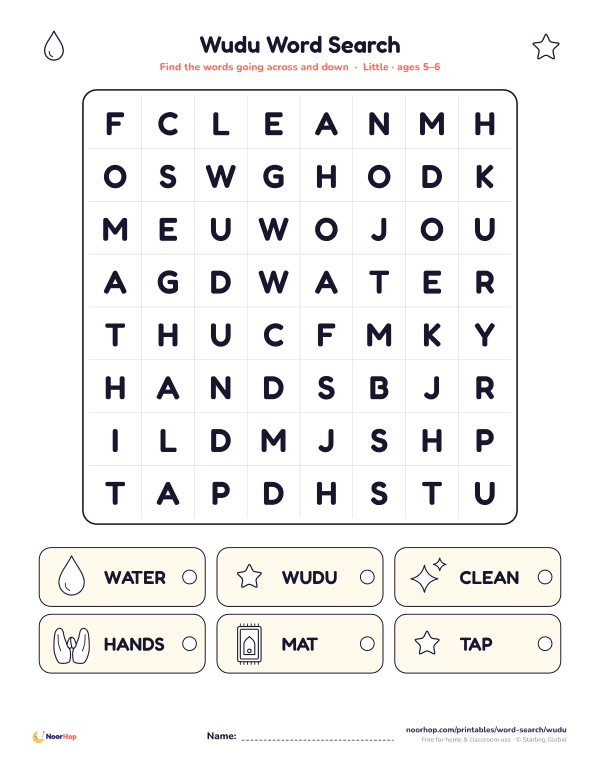
Wudu Word Search for Kids
A wudu word search in two levels: find WATER, HANDS and CLEAN in the picture puzzle, then BISMILLAH, MOUTH, NOSE and FEET in the bigger grid.
Open →Salah for kids, step by step
The steps of salah for kids, with the words to say, audio and a printable card.
Open →How to teach your child salah, age by age (2–8)
Love first, then copying, then words and positions — and charts that encourage, not shame.
Open →Du'a for Every Moment
Tap a moment to hear its du'a, track what your child knows, pick a du'a of the week and print personalised cards.
Open →Ramadan day 14: Wudu: Fresh and Ready
Kind hearts, close to Allah · Wudu is the special washing Muslims do before salah.
Open →