Why love comes first
Young children don't learn salah from instructions. They learn it by watching someone they love stop what they're doing, stand still and talk to Allah — calmly, every day. If prayer feels warm and safe, the details come later and they stick. If it feels like nagging, the details arrive with a knot in the tummy.
So the first job isn't teaching. It's showing. Pray where your child can see you. Smile when they wander onto your mat. Talk about Allah as the One who made the moon, the rain and their favourite fruit, and who loves to hear from them. A little wonder now does more than a long lecture later.
Treat the ages below as gentle stages, not deadlines. They overlap, and every child moves at their own pace. For little ones, salah is something they grow into — not a test they can fail.
Ages 2–3: pray beside me
At this age, copying is the lesson. Your toddler may stand for a moment, bow once, put their forehead down and then roll off to look under the sofa. That's a lovely prayer for a two-year-old.
- Give them their own mat. A small rug or towel that is theirs. Rolling it out and putting it away is half the fun. Colour a paper prayer mat together too.
- Invite, don't insist. “I'm going to pray. Do you want to pray next to me?” If the answer is no, pray anyway, cheerfully.
- Two little words. Let them say Allahu Akbar with you as you begin, and “Ameen” when you finish Al-Fatiha.
- Expect climbing and chatter. It passes, and your calm is part of what they learn.
- Say something warm afterwards. “I loved praying with you.” At two, that sentence is the whole lesson plan.
Ages 4–5: positions and words
Four- and five-year-olds love knowing the proper name of everything. Turn the positions into a game of “show me”:
- Standing (qiyam) — tall and still, facing the qibla.
- Bowing (ruku') — hands on knees, back flat like a table.
- Prostrating (sujud) — forehead gently down on the mat.
- Sitting — resting on the mat between the two prostrations, and for the tashahhud near the end (and after two rak'ahs in longer prayers).
Then add the words: “Allahu Akbar” to begin and as you move through the prayer, “Ameen” after Al-Fatiha, and the salaam at the end — “Assalamu alaikum wa rahmatullah” — turning to the right, then the left. Families and madhhabs differ on details, such as where the hands rest — ask your teacher which way your family follows.
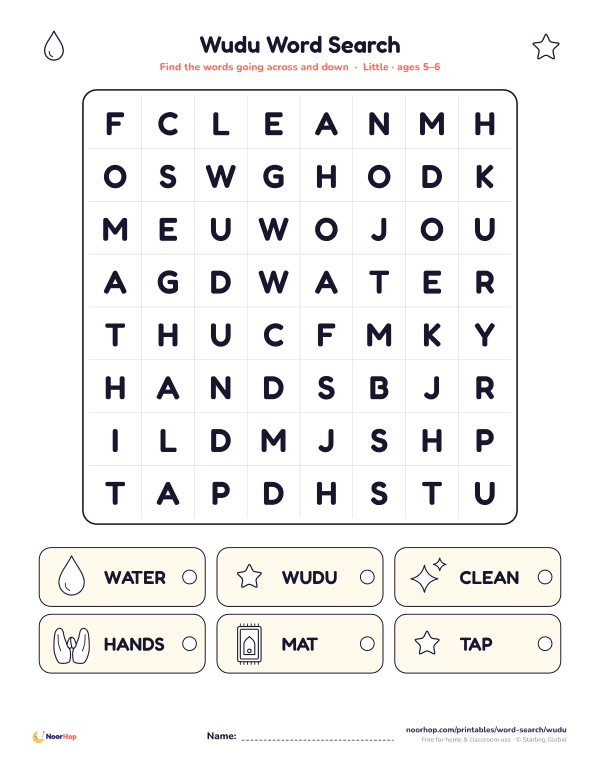
- Make wudu together. It's water play with a purpose, which makes it a perfect starting point. Do it side by side at the sink, then put the steps in order in the Wudu Steps game. Our wudu and salah pages go step by step.
- Let them hear Al-Fatiha often. In the car, before bed, in your own prayer. Sounds that are familiar are much easier to learn later.
- One rak'ah with you is plenty. Let them drift off when they're done. Stopping while it's still fun is a skill.
Ages 6–8: one prayer a day and Al-Fatiha
Many families begin more structured teaching around seven, following the hadith (Sunan Abi Dawud 495) about teaching children to pray at seven and being firmer about it at ten. Firm never has to mean harsh. In practice, “structured” can simply mean one prayer together, every day, at the same time.
- Pick the prayer that fits your day. For most families that's Maghrib or Isha, when everyone is home. Add others gradually.
- Learn Al-Fatiha in parts. One or two ayahs a week. You say a line, they echo it, then you say it together. When they can say it alone, celebrate.
- Add the short phrases. “Subhana Rabbiyal 'Adheem” (Glory be to my Lord, the Most Great) in bowing and “Subhana Rabbiyal A'la” (Glory be to my Lord, the Most High) in prostration — two short lines of praise.
- Learn the five prayer names. Fajr, Dhuhr, Asr, Maghrib and Isha. Spot them in the day: “The sun's going down. Which prayer is next?”
- Give them a job. Rolling out the family's mats, calling everyone to pray, or choosing the du'a afterwards. Our everyday du'as guide has short ones to start with.
For more ideas at each stage, see the roadmap for ages 2–3, ages 4–5 and ages 6–8.
Making a salah corner
A special spot tells children that prayer matters. Build it together so it feels like theirs:
- A quiet spot away from the TV and the toy box.
- Their mat folded in a basket next to yours, with a cap or scarf if your family uses them.
- A small arrow or sticker showing the qibla, the direction of the Kaaba.
- A wudu steps poster by the bathroom sink, and their salah chart at eye level.
- Their own artwork: the wudu water jug or our masjid colouring pages.
Charts that encourage, not shame
A chart helps children notice each prayer they try. It goes wrong when it turns into a scorecard. A few simple rules keep it kind:
- Colour a moon for every try, wobbly ones included.
- For under-sixes, one or two rows like “prayed beside a grown-up”. From around seven, a row for each prayer you pray together.
- No X marks, red boxes or sad faces. If a prayer is missed, simply start again at the next one. Don't mention the gap.
- Praise is the reward: a hug, a high five, telling Grandma.
One rule matters most: salah is never a currency. Please don't trade prayers for screen time, sweets or toys. Children quickly decide that anything you have to pay them for must be unpleasant. Make a personalised salah chart in Chart Studio, and read how to keep charts from backfiring.
When they don't want to
Almost every child goes through it. Usually it's about tiredness, timing or a power struggle — not about faith.
- Keep it short. A two-minute prayer they enjoy beats a ten-minute one they dread.
- Watch the timing. Hungry, sleepy or in the middle of a game is the hardest moment. Give a five-minute warning.
- Offer choices, not a yes-or-no. For over-fives, try “Blue mat or green mat?” or “Next to me or next to Baba?”
- Talk about love, not fear. Leave out threats. Talk about Allah hearing them, loving them and answering their du'a. Children run towards love.
- Make the masjid a happy place. Short visits and friendly faces. Practise the walk there in Noori's Way to the Masjid.
If the refusing goes on for weeks, ease off for a while, keep praying where they can see you, and start again small. If you're worried, your teacher or imam can give advice that fits your family.