
Salah chart for kids
A salah chart helps young children notice and celebrate each prayer they try with you — it's a picture of effort, not a scorecard. For little ones, track “prayed beside a grown-up”; for older children, a row for each of the five prayers.
Teacher review under way.
Choose a chart
Who is it for?
Pick the habits
4 of 5- One salah together
- Made wudu
- Said Allahu Akbar
- Made a du'a
Make it yours
Preview · A4
At the end of the week
Sit together and ask: “What did you try hardest at?” Praise the effort, not a score. Ideas:
- “I saw how hard you tried. That made me so happy.”
- “You remembered all by yourself!”
- “We did it together — you're a great helper.”
- “Even when it was tricky, you kept trying. MashaAllah!”
Make it stick
What to put on a salah chart, by age
Copying is the lesson. One or two rows — “prayed beside a grown-up”, “said Allahu Akbar” — and a moon to colour whenever they join in, even for a single sajdah.
One salah together each day, plus making wudu and making a du'a afterwards. Short and happy beats long and tearful.
Many families start a row for each prayer around age seven. Begin with the prayers that fit your day (often Maghrib and Isha) and add the others gradually.
Using it gently
- Pray where your child can see you. Children copy what they love.
- Give them their own prayer mat to roll out and put away.
- If a prayer is missed, simply start again at the next one. No talk about empty boxes.
- Families and madhhabs differ on details — ask your teacher about method.
Questions parents ask
When should children start praying?
Many families begin gentle, playful prayer from the toddler years and more structured practice around age seven, following the hadith about teaching children to pray at seven (Sunan Abi Dawud 495; Jami' at-Tirmidhi 407). Before that, the goal is love: praying beside you, learning the words, enjoying the masjid. Ask your teacher for guidance for your family.
Should a salah chart have rewards?
Praise, a hug and telling Dad or Grandma are enough for most children. Please don't trade prayers for screen time or sweets — salah isn't a currency, and children feel the difference.
Weekly or monthly salah chart?
Weekly for under-sixes: it's short enough to finish and feel proud. A monthly chart suits 6–8 year olds who are praying most days.
More charts to personalise
Keep learning
How to teach your child salah, age by age (2–8)
Love first, then copying, then words and positions — and charts that encourage, not shame.
Open →Du'a after wudu
There is only one Allah, and Prophet Muhammad (peace be upon him) is His servant and messenger.
Open →Wudu Steps
Put the steps in order!
Open →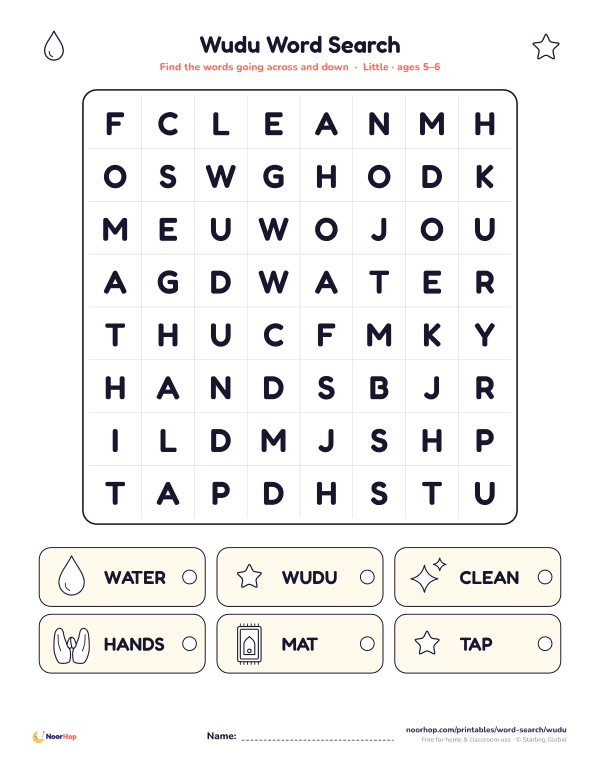
Wudu Word Search for Kids
A wudu word search in two levels: find WATER, HANDS and CLEAN in the picture puzzle, then BISMILLAH, MOUTH, NOSE and FEET in the bigger grid.
Open →Salah for kids, step by step
The steps of salah for kids, with the words to say, audio and a printable card.
Open →Ramadan day 14: Wudu: Fresh and Ready
Kind hearts, close to Allah · Wudu is the special washing Muslims do before salah.
Open →