
Islamic learning for 2 and 3 year olds
At two and three, children learn by copying the people they love. Faith is a feeling first: warmth when you say Bismillah, wonder at the moon, joy at the masjid. Short words, lots of repetition, no pressure.
Teacher review under way.
Three ideas for your child
0 of 22 milestones “got it!” · Ages 2–3
- Allah & wonder
Take a 10-minute “Allah made it” walk: collect a leaf, a stone and a flower, and say “Alhamdulillah” for each one.
Word: SubhanAllah — meaning for kids → - Salah & wudu
Put a little prayer mat next to yours for one prayer each day this week, and say “Allahu Akbar!” together at the start.
Colouring: My Prayer Mat → - Du'as & words
Choose one moment — meals — and say Bismillah together every single time this week. Sing “Every Bite's a Gift” at lunch.
Du'a: Du'a before eating →
Allah & wonder
Wonder comes before words. Toddlers can feel that Allah made the things they love — the moon, the rain, bananas, ducks.
Hears “Allah made…” about the sun, rain, animals and food
Try: On a walk, point and ask “Who made the moon?” — then answer happily together: “Allah made the moon!”
Says “SubhanAllah” or “MashaAllah” with you at something lovely
Try: A rainbow, a big truck, a tiny snail — say it together in your most delighted voice.
Knows we say “Alhamdulillah” when something good happens
Try: Say it when they finish a meal, find a lost toy or see Grandma at the door.
Take a 10-minute “Allah made it” walk: collect a leaf, a stone and a flower, and say “Alhamdulillah” for each one.
Explanations and big questions can wait. If they ask, keep answers short and warm — and ask your teacher for wording you're comfortable with.
Salah & wudu
Copying is the lesson. Toddlers love to stand next to you, bow when you bow and put their head down when you go into sajdah.
Stands beside a grown-up for part of a prayer
Try: Lay a small mat next to yours. A few seconds counts — wandering off is normal.
Copies bowing and sajdah
Try: If they climb on your back, smile and carry on. They're learning that salah is a happy place.
Splashes hands and face with you before salah
Try: Make the sink a game: “Bismillah… splash, splash!”
Put a little prayer mat next to yours for one prayer each day this week, and say “Allahu Akbar!” together at the start.
The order of wudu, the words of salah and praying a whole prayer can all wait.
Du'as & words
Little words tied to real moments. They won't say them perfectly — hearing you say them, every time, is what matters.
Says (or tries to say) “Bismillah” before eating
Try: Pause with the spoon in the air and say it together, then the first bite.
Says “Alhamdulillah” after a sneeze
Try: Make it a fun, big moment: “Achoo! … Alhamdulillah!”
Says or waves “salaam” to family
Try: Practise at the front door with teddies, then with Grandpa on a video call.
Choose one moment — meals — and say Bismillah together every single time this week. Sing “Every Bite's a Gift” at lunch.
Long du'as and their meanings can wait. One word at the right moment is a wonderful start.
Qur'an & Arabic letters
Listening comes first. Toddlers enjoy the sound of recitation and can start to notice the shapes of a few letters.
Listens calmly to a short recitation for a minute
Try: Play a short surah softly in the car or at bedtime — the same one for a week.
Joins in “Ameen” after Al-Fatiha
Try: Say a big, happy “Ameen” together when you finish reciting it.
Points to the letters alif and baa
Try: Trace alif with a finger — top to bottom — and say “aa-lif!”
Colour the letter alif page together, then go on a hunt for straight “alif” lines around the house.
Reading, writing and memorising surahs can wait. Love for the sound of the Qur'an is the goal now.
Manners
Manners at two are about gentle hands, tidying with help and waiting for a tiny moment — with lots of modelling.
Uses gentle hands with babies and pets
Try: Show “gentle” with a soft stroke on your arm, then on a teddy.
Helps tidy toys with you
Try: One box for everything, a tidy-up song and lots of thanks.
Takes a turn for a moment, with help
Try: Roll a ball back and forth: “My turn… your turn!”
Play a turn-taking game with one ball and sing “My Turn, Your Turn” while you play.
Sharing without help and saying sorry on their own come later. Prompting now is perfectly normal.
Ramadan & Eid
Toddlers don't fast — they join in with lights, moon-watching, jobs at iftar and the excitement of Eid.
Knows Ramadan is a special month that starts with the moon
Try: Look for the moon in the evening sky: “Ramadan is coming!”
Helps pass the dates at iftar
Try: Give them the date bowl. A real job feels big.
Puts a coin in a sadaqah jar
Try: Use a clear jar so they can watch it fill.
Joins in with “Eid Mubarak!”
Try: Practise on toys the night before Eid.
Make a sadaqah jar from a clean jar and a label, and add a coin together on Friday.
Fasting isn't for toddlers. Keep Ramadan sensory, short and joyful.
Stories & seasons
Short stories, the moon and a special Friday give toddlers a sense of the rhythm of the Muslim year.
Enjoys short stories about animals and kindness
Try: Act stories out with toys — it's the voices they'll remember.
Notices the moon changes shape
Try: Look from the window each evening: “Thin moon? Round moon?”
Knows Friday feels special
Try: A special breakfast or nice clothes on Fridays makes the day stand out.
Each evening, look for the moon from the window and draw what it looks like on a calendar.
Long Prophet stories can wait. When you share them, keep them short and told in your own words.
Ticks are saved on this device. With a free family account they follow your child to every device. Every child is different — these are gentle signposts, not tests.
Keep learning
What do we say?
Pick the right words!
Open →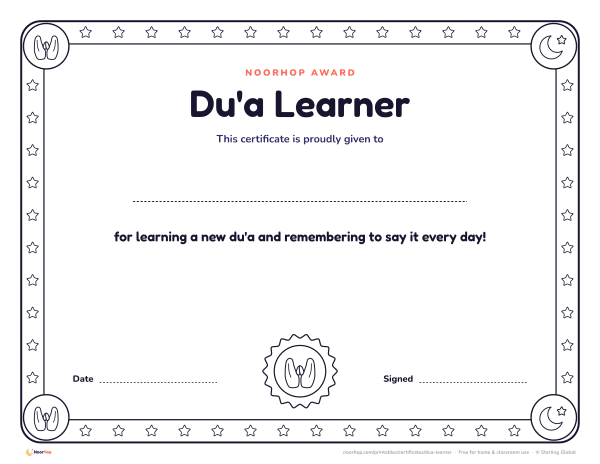
Du'a Learner Certificate for Kids
The Du'a Learner certificate says “well done” for learning a new du'a and remembering to say it every day.
Open →Bismillah — meaning for kids
I'm starting with Allah's name.
Open →Salah for kids, step by step
The steps of salah for kids, with the words to say, audio and a printable card.
Open →Everyday du'as for kids: how to teach them, moment by moment
Which du'as first, a 5-step method, and the daily moments that make them stick.
Open →Ramadan day 26: Allahu Akbar
The last ten nights · “Allahu Akbar” means Allah is the Greatest — greater than anything we can imagine.
Open →