
Islamic learning for 6, 7 and 8 year olds
Between six and eight, children can understand the 'why' and start to own small acts of worship. Many families begin a daily salah together, short surahs and practice fasts — always gently, with lots of praise for trying.
Teacher review under way.
Three ideas for your child
0 of 24 milestones “got it!” · Ages 6–8
- Allah & wonder
Start a tiny thank-you journal: each night, one thing to thank Allah for — written or drawn.
Word: InshaAllah — meaning for kids → - Salah & wudu
Print a salah chart with the prayers you'll pray together and colour a moon after each one.
Tool: Salah practice chart → - Du'as & words
Make them the du'a leader in the car this week: they start the travel du'a and everyone joins in.
Du'a: Du'a for travelling →
Allah & wonder
Six to eight year olds can understand the “why” and start to think for themselves. Welcome their questions — that's faith growing.
Can say in their own words that Allah made everything and nothing is like Him
Try: Ask: “What's something only Allah can make?” and listen.
Thinks of Allah when they see the sky, seeds or rain
Try: Pause together at a sunset: “SubhanAllah — who paints the sky?”
Says “InshaAllah” about plans and trusts Allah when things go wrong
Try: Model it: “We'll go to the park tomorrow, InshaAllah.”
Start a tiny thank-you journal: each night, one thing to thank Allah for — written or drawn.
Deep questions about the unseen: welcome them, answer honestly and say “Let's ask our teacher” when you're not sure.
Salah & wudu
Many families begin a daily salah together around seven. Build up gently, praise every prayer and reset kindly after a missed one.
Prays at least one salah a day with you
Try: Choose the prayers that fit your day and add more slowly.
Knows the names of the five prayers and roughly when they are
Try: Match each prayer to the sky: dawn, midday, afternoon, sunset, night.
Does wudu on their own with the odd reminder
Try: A picture guide at the sink until they don't need it.
Is learning the words of salah, starting with Al-Fatiha
Try: One part at a time; let them lead the family in “Allahu Akbar”.
Print a salah chart with the prayers you'll pray together and colour a moon after each one.
All five prayers every day without help is something many families build up to between about seven and ten — gently.
Du'as & words
Children can now learn the meaning of the du'as they say — which makes them their own.
Knows the everyday du'as for waking, eating, leaving home, travel and sleep
Try: Let them be the “du'a leader” at each moment.
Knows what each du'a they say means
Try: Ask them to explain a du'a to a younger sibling.
Says a few words of remembrance with you, morning or evening
Try: Three short phrases at breakfast is plenty.
Make them the du'a leader in the car this week: they start the travel du'a and everyone joins in.
Long collections of adhkar can wait.
Qur'an & Arabic letters
With a teacher or at home, many children this age memorise short surahs and start reading letters with their vowel marks.
Knows Al-Fatiha by heart
Try: Recite it together before bed and let them lead.
Knows the last three surahs (Al-Ikhlas, Al-Falaq and An-Nas), or is learning them
Try: One ayah a day, repeated at meals and in the car.
Reads letters with fatha, kasra and damma
Try: Short daily practice beats one long session a week.
Learn one ayah a day this week: say it at breakfast, in the car and at bedtime.
Fluent reading and tajweed take years, ideally with a teacher. Keep it loving, not rushed.
Manners
Older children can own their manners: real jobs at home, honesty when it's hard, kindness to parents.
Shares and takes turns without reminders, most of the time
Try: Notice the quiet moments of sharing, not just the arguments.
Tells the truth even when it's hard
Try: Keep calm when they confess — make honesty feel safe.
Does one real job at home each day
Try: Let them choose the job; rotate it each week.
Is kind to parents: gentle words, no eye-rolling “uff” (mostly!)
Try: Thank them for kind words out loud.
Each child chooses one helping job for the week. Print a chore chart together and colour a star for each try.
Patience with brothers and sisters is a lifelong project — for all of us.
Ramadan & Eid
Fasting isn't required before puberty, but many 6–8 year olds want to try. A gentle ladder, sadaqah of their own and a little of the last ten nights make it theirs.
Tries practice fasts that grow slowly
Try: Until mid-morning, then Dhuhr, then Asr — stopping early is still a try.
Gives sadaqah from their own money
Try: Let them choose who it helps.
Joins a little night-time du'a in the last ten nights
Try: A cosy blanket, a lantern and a short du'a before bed.
Helps plan Eid for others: cards, decorations, gifts
Try: A card for a neighbour or a gift for a younger cousin.
Plan a practice-fast ladder together in the Ramadan Planner and let them choose the first goal.
Daily full fasts can wait. Follow your child's energy, and check with your doctor if they have a health condition.
Stories & seasons
Children this age can hold the shape of the Islamic year and retell stories of the Prophets in their own words.
Knows the Islamic months in order, or most of them
Try: Say them in the car like a song, a few at a time.
Retells a story of a Prophet in their own words
Try: Tell it with words and imagination — no pictures of the Prophets.
Knows why Jumu'ah and the two Eids are special
Try: Talk about what your family does on each — and why.
Keep a moon diary for one month: draw the moon each night and watch a new month begin.
Detailed history and dates can wait.
Ticks are saved on this device. With a free family account they follow your child to every device. Every child is different — these are gentle signposts, not tests.
Keep learning
What do we say?
Pick the right words!
Open →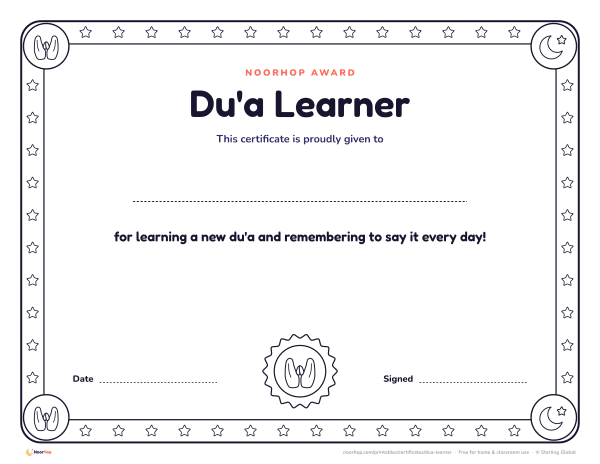
Du'a Learner Certificate for Kids
The Du'a Learner certificate says “well done” for learning a new du'a and remembering to say it every day.
Open →Bismillah — meaning for kids
I'm starting with Allah's name.
Open →Salah for kids, step by step
The steps of salah for kids, with the words to say, audio and a printable card.
Open →Everyday du'as for kids: how to teach them, moment by moment
Which du'as first, a 5-step method, and the daily moments that make them stick.
Open →Ramadan day 26: Allahu Akbar
The last ten nights · “Allahu Akbar” means Allah is the Greatest — greater than anything we can imagine.
Open →