
Sharing and taking turns
Islam teaches children to share and take turns because we should love for others what we love for ourselves. Practise with a turn-taking timer and celebrate every handover.
Teacher review under way.
What it means for little ones
Sharing means letting others enjoy things too. Taking turns means everyone gets a go: me, then you, then me again. When we wait nicely and share, playtime is fair and everyone is happy.
Where it comes from
Our Prophet (peace be upon him) taught that none of us truly believes until we love for our brother or sister what we love for ourselves.
What it looks like
- Wait for my turn and count while I wait
- Ask: “Can I have a turn when you're done?”
- Offer: “Do you want a go?”
- Invite the new child to join in
Questions to ask
- How did you feel when a friend gave you a turn?
- What's something you love that you could share today?
- What can we say if someone won't share with us?
- How can we make sure everyone gets a turn?
Turn-taking timer
Step 1: Pick one favourite toy and a timer (or count to 20 together).
Step 2: Take turns: when the timer ends, hand the toy over and say “Your turn!”
Step 3: Cheer for each handover — waiting is the hard part.
Step 4: Finish by asking: “What did it feel like to wait? To share?”
For parents: It's fine for a child to have one or two special things that are just theirs. Sharing grows with age — celebrate small steps.
Questions parents ask
My toddler won't share. Is that normal?
Very normal — sharing is a skill that grows with age. Model it, use a timer, and praise every small try.
Should I force my child to share?
Gentle guidance works better than forcing. Turn-taking (“you can have it when the timer ends”) feels fairer to children.
Sources: Sahih al-Bukhari 13
Qur'an references are checked on quran.com and hadith on sunnah.com; a teacher review is under way. Families and madhhabs differ on some details — ask your teacher.
Keep learning
Good Deeds Garden
Grow a garden of kindness!
Open →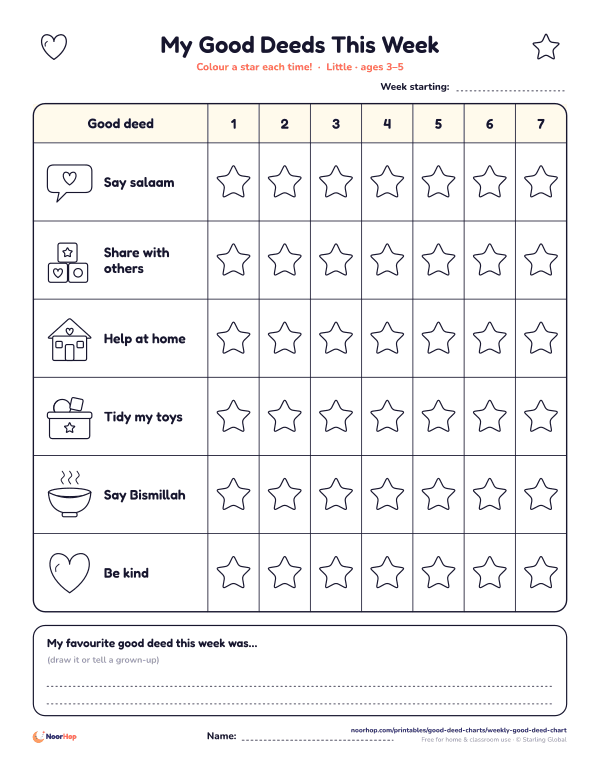
Weekly Good Deeds Chart for Kids
A weekly good deeds chart in two levels: Little (ages 3–5) has six picture deeds and big stars; Big (ages 6–8) has eight deeds such as speaking kindly and keeping promises.
Open →Good deeds chart for kids
Personalise and print a free good deeds week chart.
Open →My Turn, Your Turn
Watch on YouTube ↗Assalamu alaikum — meaning for kids
Peace be with you!
Open →25 sunnah habits & good manners for kids (with songs)
Table, home, friends, family and nature — 25 little sunnahs with songs to match.
Open →